
Last month, a founder told me something painfully honest: “We run surveys every quarter… but I don’t think anything really changes.”
It wasn’t said with defensiveness. It was said with fatigue.
And that’s exactly where most organizations are. Not because they don’t care, but because somewhere between collecting feedback and acting on it, the process quietly breaks.
The Illusion of Listening
On paper, everything looks right:
- You launch a survey.
- Employees respond.
- HR compiles insights.
- Leadership reviews the report.
Tick. Tick. Tick.
But in the employee’s lived experience, they shared what’s not working and then… nothing. No visible action. No communication. No closure.
The message becomes clear: “You asked, but you didn’t really listen.” That is where trust starts eroding – not loudly, but quietly.
The Problem: Why It Actually Breaks
Surveys don’t fail because of low participation. They fail because of design and ownership:
- The “Average” Fallacy: A salesperson chasing targets and an engineer building in sprints are not experiencing the same organization. When you send them the same generic form, you get data, but you miss the insight.
- Too Much Data: Everything feels important, so nothing gets done.
- Diffused Ownership: HR holds the insights, but the Business needs to act. The ball gets dropped in the handoff.
- The “Uncomfortable” Gap: Real issues (manager behavior, accountability) are messy, so leadership pivots to “safer” perks.
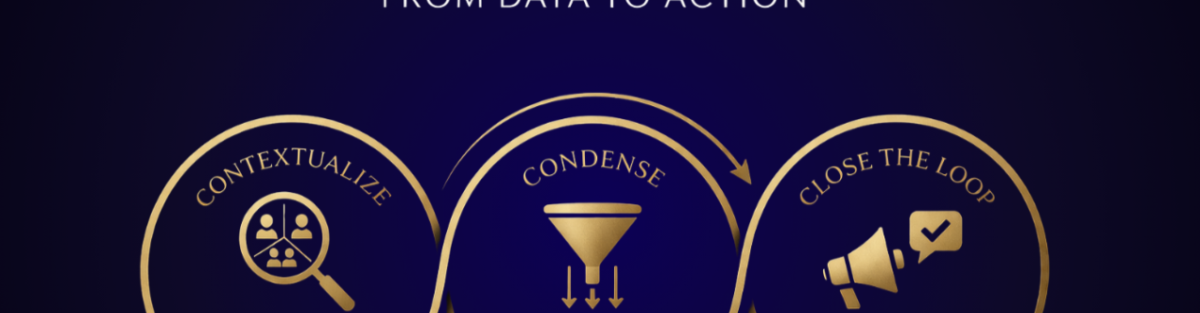
The Way Forward: The 3-C Feedback Framework
To move from “collecting opinions” to “creating visible change,” I use this framework with my clients:
- Contextualize (Function & Tenure) Stop the one-size-fits-all approach. A 3-month hire is decoding culture; a 10-year veteran is decoding leadership consistency. Ask them different questions.
- Condense (The Rule of 3) Resist the urge to solve 15 items. Pick 2-3 visible friction points and solve them obsessively. Credibility builds faster through one small, visible shift than a 40-page action plan.
- Close the Loop (Radical Transparency) Silence destroys trust. Tell your team:
- “This is what we heard.”
- “This is what we are changing.”
- “This is what we are NOT changing – and why.”
Case Study: From “Transparency” to “Context”
I worked with a growth-stage startup where “Transparency” scores were plummeting.
- The Assumption: Leadership thought they needed more All-Hands meetings.
- The Reality: After digging into functional segments, we found the Product team felt they were the last to know about Sales pivots.
- The Action: We skipped the generic “Culture Workshop” and implemented a simple 10-minute weekly Cross-Functional Context Sync.
- The Result: Engagement rose by 40% because the solution targeted a specific friction point.
The Founder Lens
Employee feedback is not an HR activity; it’s a reflection of leadership maturity.
People don’t disengage when you ask questions, they disengage when they realize nothing moves after. Don’t aim to be an organization that runs great surveys. Aim to be one where people can say:
👉 “When we speak, something actually moves.”
That’s when feedback becomes culture.