

Everyone’s talking about “fractional HR” now. Most are doing it wrong. And your organization is paying the price.
In over two decades working closely with founders and leadership teams and now building GyroHR, I’ve learned something crucial: fractional HR isn’t just a staffing model. When done right, it’s a stabilizing force that shapes whether your organization scales or implodes.
The Reality Check Organizations Need:
Most organizations don’t struggle because they lack HR support. They struggle because their people decisions are misaligned with their business reality.
- Startups wrestle with speed vs structure, talent quality vs affordability, and intuition vs systems.
- MSMEs often reach a point where informal practices stop working, but formalization feels disruptive.
- Organizations in transition (cost resets, leadership changes, mergers, or scale corrections) face uncertainty, emotional fatigue, and the pressure to make tough people decisions quickly.
What’s missing in all these scenarios is contextual, senior HR thinking, not more policies or administration.
This is where #FractionalHR creates real value.
What This Looks Like in Practice
Case 1: An MSME Outgrowing its Informal Roots
A family-led MSME had hit stagnation after steady growth. Decision-making was centralized, newer employees couldn’t integrate, and performance was relationship-driven instead of role-driven. What they needed wasn’t an HR person to hire and fire, they needed someone to help them professionalize without destroying trust.
Fractional HR intervention began with listening. Gradually, role clarity, performance expectations, and people systems were introduced, without disrupting trust or legacy. Leaders shifted from control to accountability, and employees gained clearer growth pathways.
Value created: Professionalized people practices while preserving organizational identity.
Case 2: An Organization in Transition and Cost Reset
A mid-sized organization faced market pressure and needed to realign costs. Leadership knew difficult people decisions were inevitable but struggled with how to execute them humanely.
Fractional HR acted as a steady external anchor – helping assess options, sequence decisions, and communicate with honesty and dignity. Alongside people cost optimization, leadership behaviors were stabilized and trust rebuilt post-change. People understood the why. They saw decisions as principled, not arbitrary.
Value created: Enabled decisive yet humane transformation, protecting long-term organizational health.
Where Fractional HR Creates Real Value
Traditional
HR hiring often swings between extremes: hiring too junior (execution without perspective) or hiring too senior (cost pressure and role mismatch). Fractional HR avoids both traps.
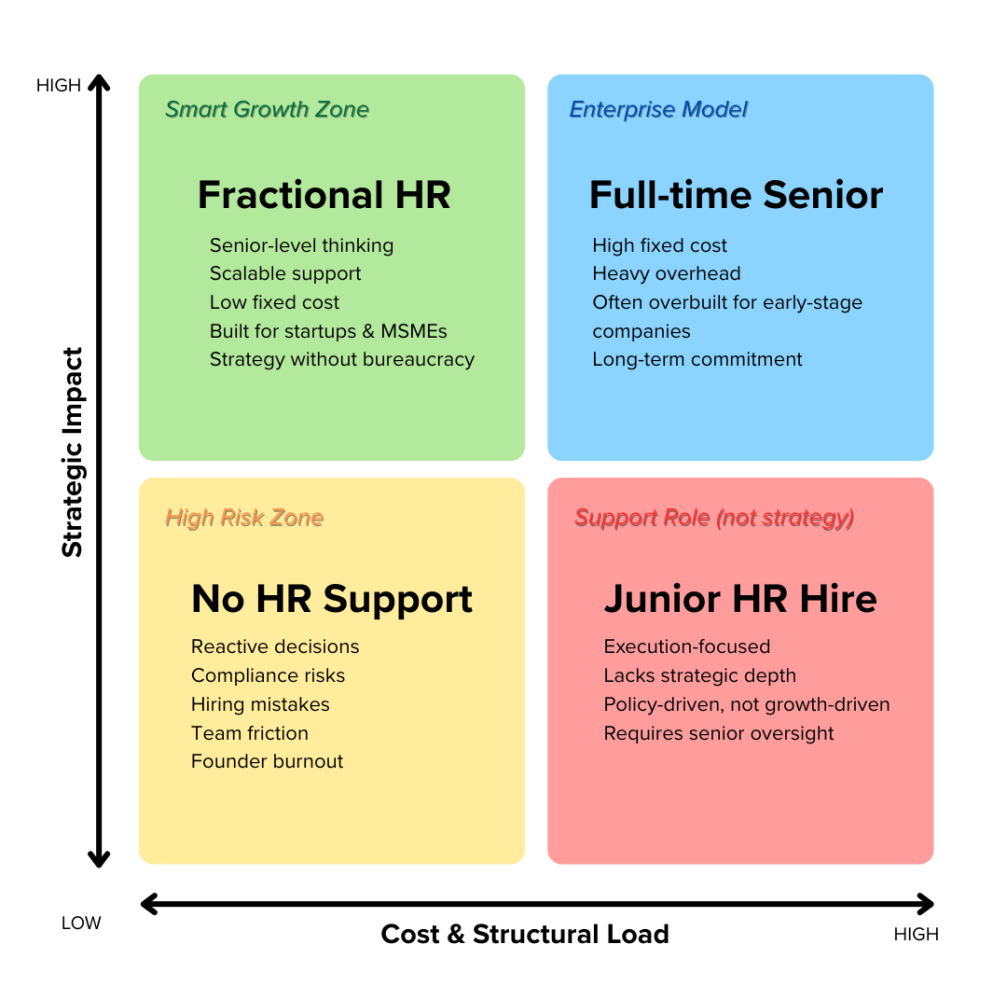
The sweet spot for startups, MSMEs, and organizations in transition? Top-left: senior HR thinking with minimal overhead. That’s fractional HR. You get strategic perspective exactly where it matters most, with the flexibility to scale involvement up or down based on what you’re navigating.
Why Fractional HR Works When Everything Else Stalls
During transformation, fractional HR does something traditional models can’t:
- Provides a calm, external perspective when internal teams are emotionally loaded
- Helps leaders make principled decisions under pressure
- Ensures communication is clear, timely, and humane
- Holds the organization steady while it redefines itself
- Builds people maturity instead of creating dependency
In these moments, fractional HR becomes more than a service. It becomes the difference between a business that adapts and one that breaks.
What Fractional HR Is (And Isn’t)
At GyroHR Consulting, we see fractional HR as a partnership through critical phases – not a transactional arrangement and not a permanent crutch. It’s about building organizational capacity to make better people decisions, faster and with more confidence.
For startups scaling at the speed of market opportunity. For MSMEs navigating the shift from informal to professional. For any organization in transition that needs a steady hand and senior perspective at exactly the right moments.
Fractional HR adds value because it’s aligned with where you actually are and where you’re trying to go. And in the moments that shape the future of your business, that alignment makes all the difference.