

For many years in the corporate world, Learning & Development was measured by activity, not impact.
- How many people attended a workshop?
- How many training hours were delivered?
- How many participants filled out a “smile sheet” saying the session was good?
But after two decades in HR, I’ve realized something: Business leaders don’t invest in attendance. They invest in outcomes.
And that is where the real shift needs to happen.
The Shift: From Delivery to Performance
Traditionally, trainers were viewed as content deliverers.
Their responsibility was to conduct sessions, explain concepts, and ensure participants completed a course. The success of training was often measured through participation, feedback forms, or course completion rates.
But in today’s fast-moving business environment, that model is no longer enough.
They need learning partners who understand business problems first and training second.
A Partner stops asking “What should we teach?” and starts asking:
- What business challenge are we trying to solve?
- Where exactly is the performance gap?
- Is this really a training issue, or is it a process, capability, or mindset gap?
- How will we measure improvement after the intervention?
This approach shifts the focus from delivering sessions to driving measurable change.
Why Context is King
At GyroHR, we see this most clearly in scaling companies. When you grow fast, generic workshops don’t stick and training cannot exist in isolation. You face specific friction:
- New managers stepping into leadership roles.
- Teams expanding faster than capability building.
- Communication gaps across functions.
- Young professionals entering the workforce without workplace readiness.
In such environments, generic training programs rarely create lasting impact.
What works instead are context-driven, tailored learning solutions that are built around the organization’s stage of growth, its culture, and its real operational challenges.
This is the philosophy we follow in our work.
The Diagnostic Approach
Rather than offering standard workshops, we approach training engagements as partnerships in capability building.
Our starting point is always diagnosis.
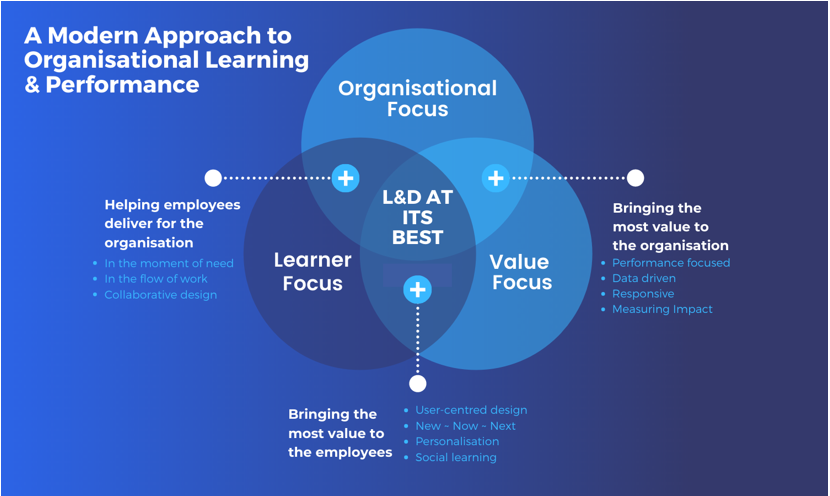
True impact isn’t found in the circles; it is found in the margins where they intersect.
Most programs fail because they isolate a single focus: an organizational mandate, a learner “perk,” or a sterile metric.
Before we design a single slide, we work with leadership to map:
- Business Goals & Growth Plans: Where are you going?
- Capability Gaps: What is stopping the team?
- Behavioral & Leadership Challenges: What needs to shift?
- Expected Outcomes: How will we measure success of learning interventions.
Only after that do we design the solution.
Sometimes, the answer isn’t training at all, it’s coaching or process redesign.
The goal is always the same: Move from learning activity to business impact.
Why This Approach Matters
When learning is aligned with business priorities, something powerful happens.
Training stops being seen as a cost center.
Instead, it becomes a strategic enabler of growth.
Managers become better leaders. Teams communicate more effectively. Employees become more confident and capable. And organizations move faster toward their goals.
That is the difference between running training programs and partnering to build hi- performance
The Bottom Line
The goal is not simply to teach.
The goal is to unlock potential, shift behaviors, and help organizations grow through people capability.
And in my view, that is where the future of Learning & Development truly lies.